
Wall-Hung vs Floor Standing vs Two-Piece Toilets: How to Choose
Choosing between a wall hung toilet, a floor standing toilet, and a two piece toilet is one of the first decisions in any bathroom project — whether you are fitting out a hotel, an apartment block, or a commercial building. The choice affects plumbing layout, wall structure, cleaning routines, and long-term maintenance cost. Yet most buyers compare only the product photo and the price. This guide explains the real differences between the three types, when each one makes sense, and what a B2B buyer should check before ordering from a manufacturer.
The decision also compounds at scale. A 200-room hotel does not buy one toilet; it buys 200, plus spares, plus the labour to install them and the housekeeping minutes to clean them every day. A configuration that saves five minutes of cleaning per room per day is worth more over a building’s life than a slightly lower unit price. That is why the comparison below covers installation, cleaning, maintenance, and total cost — not just the product itself.

Wall-Hung Toilets: Pros, Cons & Best Use Cases
A wall hung toilet is mounted on the wall with the cistern concealed inside the wall or behind a false panel. Only the ceramic bowl is visible, which gives the bathroom a clean, modern look and frees up floor space.
Advantages
- Floor space is fully usable. Because nothing touches the ground, cleaning is faster and there is no dirt trap around the base — a genuine advantage in hotel housekeeping.
- Modern appearance. Wall-hung toilets are the default choice in designer-led hotels, serviced apartments, and high-end residential projects.
- Accessible height control. The bowl height can be set to suit accessibility requirements, which matters for projects with disabled-access or elderly-care standards.
Considerations
- Wall structure matters. A wall-hung toilet needs a concealed support frame or a load-bearing wall. Installing the frame is additional work and cost compared with a floor-standing unit.
- Maintenance access. The cistern is hidden, so a flush plate or inspection hatch is needed to reach the mechanism.
- Higher unit cost. The ceramic bowl plus frame plus concealed cistern package costs more than a standard floor-standing toilet.

Installation detail buyers should know. The support frame transfers the full weight to the floor slab, so the ceramic bowl is not carrying the load — the practical limit is set by the frame, typically 400 kg. The concealed cistern is accessible through the flush plate, which doubles as a service hatch; specifying a frame with a removable flush plate avoids cutting into finished tiling later. If you are planning a wall-hung specification, the frame and the ceramic must be ordered and installed together, which is why we offer them as a coordinated package with the wall hung toilet range.
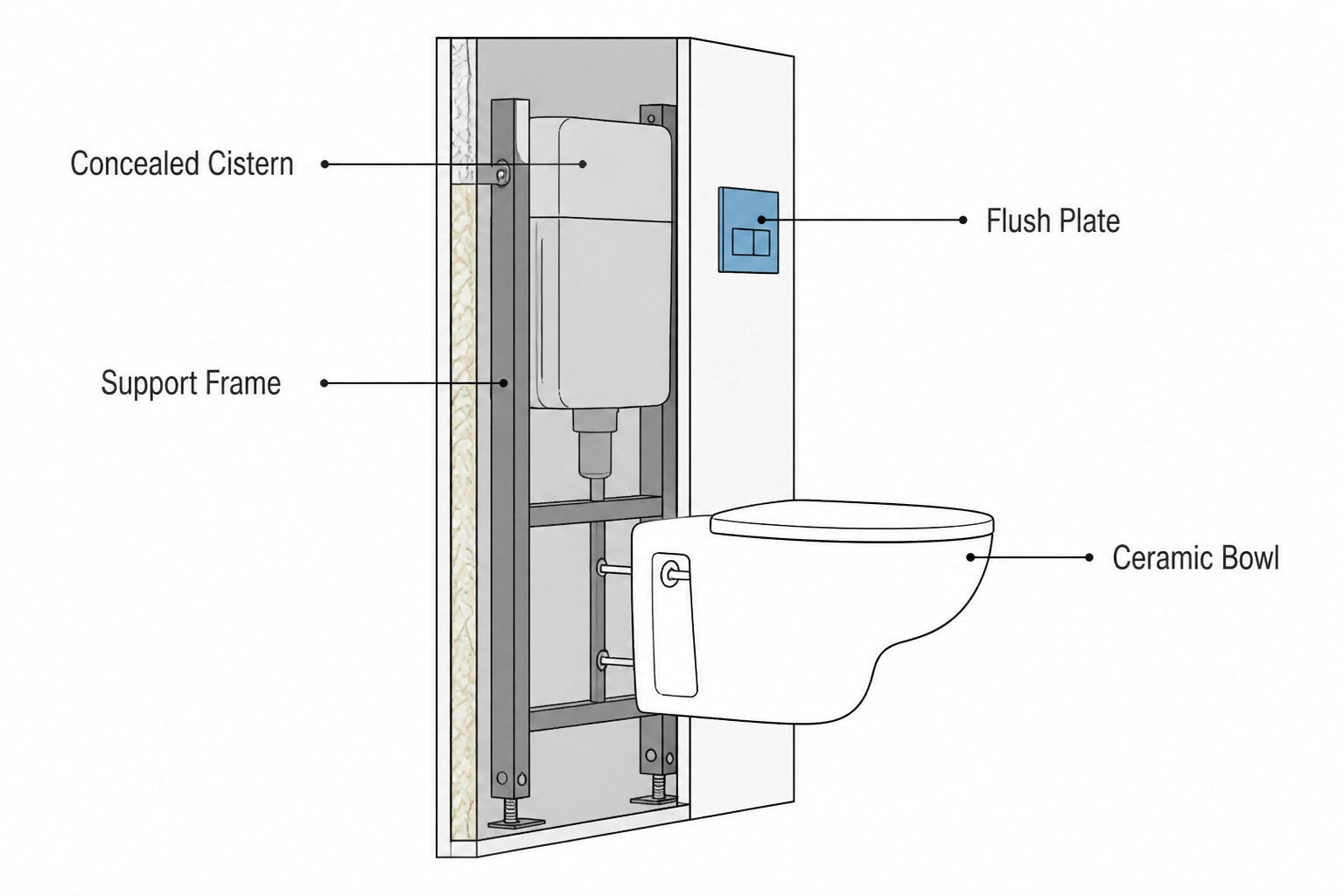

Wall-hung toilets suit new builds, hotel bathrooms where cleaning speed matters, and projects where the developer wants a consistent modern look across hundreds of rooms. Our wall hung toilet range includes rimless and tornado-flush models such as the YJ-2405 Rimless Wall Hung Toilet.
Floor Standing Toilets: Pros, Cons & Best Use Cases
A floor standing toilet sits directly on the floor with its own visible cistern. It is the most traditional configuration and the easiest to install in an existing bathroom.
Advantages
- Simple, fast installation. No frame, no wall reinforcement, no concealed cistern. A standard toilet flange and water supply are all that is needed.
- Structural stability. The weight is carried by the floor, so there are no wall-loading concerns — important in older buildings or partition walls.
- Lower cost. Floor-standing models are typically the most economical option, both in unit price and installation labour.
- Easier access to the cistern. If the flush mechanism fails, the cistern is right there; most repairs take minutes.
Considerations
- Cleaning gap at the base. The joint between the toilet and the floor is a classic dirt and moisture trap, which needs regular attention in high-turnover settings.
- Less design flexibility. Floor-standing toilets occupy visible floor area and read as more utilitarian in premium interiors.
Floor-standing toilets are the workhorse of budget hotels, staff facilities, and renovation projects where the plumbing is already in place. The floor standing toilet category covers standard, back-to-wall and tornado-flush models, including the YJ-3388 Tall Floor Standing Toilet.
Two-Piece Toilets: Pros, Cons & Best Use Cases
A two piece toilet is sold as two separate ceramic parts — a cistern and a bowl — that are joined together during installation. When the cistern sits directly on the bowl, it is called a close-coupled two-piece toilet.
Advantages
- Lowest cost per unit. Two-piece toilets are the most price-competitive option, which matters when you are equipping a large number of rooms on a fixed budget.
- Easy parts replacement. If a flush valve fails, you replace the valve, not the whole toilet. Spare parts are widely available and inexpensive.
- Wide availability. Two-piece toilets are stocked and specified globally, so maintenance teams are already familiar with them.
Considerations
- A visible joint. The seam between cistern and bowl collects dust and needs regular wiping.
- More surface to clean. Two joined units have more nooks than a one-piece or wall-hung design.
- Standard looks. For premium design-led projects, a two-piece toilet reads as less refined than a wall-hung unit.
Two-piece toilets remain the default for mid-range hotels, budget accommodation, residential developments, and anywhere total cost of ownership is the deciding factor. Our two piece toilet range includes rimless and dual-flush close-coupled models such as the YJ-8381 Dual Flush Close Coupled Toilet.
Wall-Hung vs Floor Standing vs Two-Piece: Side-by-Side Comparison
| Factor | Wall-Hung Toilet | Floor Standing Toilet | Two-Piece Toilet |
|---|---|---|---|
| Installation | Frame + concealed cistern; needs wall support | Direct floor mount; simplest | Direct floor mount; join cistern to bowl |
| Cleaning | Easiest — no floor contact | Gap at base needs attention | Joint between cistern and bowl |
| Space saving | Best — floor fully usable | None | None |
| Unit cost | Highest | Low | Lowest |
| Installation cost | Highest (frame, tiling, hatch) | Low | Low |
| Maintenance access | Via flush plate / hatch | Direct access to cistern | Direct access to cistern |
| Design feel | Modern, premium | Traditional, functional | Traditional, budget-friendly |
| Best for | Hotels, new builds, accessible bathrooms | Renovations, budget projects | Large-volume mid-range projects |

Key Buying Factors for B2B Buyers
When you buy toilets for a project rather than for one bathroom, the evaluation goes beyond the product itself. Here is what professional buyers check:
Flush performance. Look for rimless designs, which remove the hidden lip where bacteria collect, and tornado-flush systems, which use a 360° water flow for a stronger clean with less water. Dual-flush options (typically 3/6 litres) reduce water consumption across a property.

Ceramic quality. A toilet is fired ceramic — the glaze determines stain resistance and how easy it is to keep white. Ask the factory about firing temperature and glaze standards, and request a sample to check the surface finish in person.
Rough-in and bowl dimensions. For floor-standing and two-piece toilets, the rough-in distance — the gap from the finished wall to the centre of the floor drain — must match the model you specify. Common rough-ins are 305 mm (12″) and 400 mm; getting this wrong at specification stage means a costly rework on site. Confirm the bowl projection and seat height too, especially for accessible bathrooms where a comfort height (around 400–430 mm) is often required.
Total cost of ownership. Compare more than the unit price. A wall-hung installation carries frame and labour cost; a two-piece toilet carries slightly higher long-term cleaning cost and a visible seam; a floor-standing unit carries the risk of base-area staining in high-traffic bathrooms. For a large project, model the three types over a 5–10 year period — cleaning time, spare parts, and replacement labour usually outweigh the initial price difference.
Certifications. CE, CUPC and WaterMark are the certifications most often requested for export markets. Confirm which certificates the factory holds and whether they can be verified.
MOQ and lead time. For project orders, YINGJIE’s standard terms are a MOQ of 50 pcs per model and a lead time of 25–35 days, which suits renovation and new-build schedules that need predictable delivery.
OEM and customisation. If you need your own logo, custom packaging, or specific bowl heights, check whether the factory supports OEM/ODM production and how many revision rounds are included.
Packaging and QC. For export shipments, confirm the packaging standard and whether pre-shipment inspection reports are provided. A factory that shows its QC process is easier to trust than one that only claims quality.
How to Choose the Right Toilet for Your Project
Use the project profile, not personal preference, to make the call:
- New build with flexible plumbing → wall hung. You control the wall construction, so the frame and concealed cistern cost is planned in from day one. You get the easiest cleaning and the most modern look across the whole property.
- Renovation with existing floor plumbing → floor standing. The toilet flange is already in place. A floor-standing unit is the lowest-risk, fastest installation.
- Mid-range or large-volume project on a strict budget → two-piece. Close-coupled two-piece toilets deliver acceptable quality at the lowest total cost, and spare parts are easy to source anywhere.
- Mixed approach is common. Many hotel groups specify wall-hung toilets in guest bathrooms and floor-standing or two-piece units in staff and public facilities to control cost where appearance matters less.
Whatever the configuration, verify the flush type, the ceramic grade, and the certifications before ordering — and always ask for a pre-production sample on the first order.

For a deep dive into the mechanics behind the wall, see our guide to how concealed cistern toilets work — covering mounting frames, flush mechanisms and flush plate compatibility.
Frequently Asked Questions
Is a wall hung toilet stronger than a floor standing toilet?
A wall hung toilet is supported by a steel frame or a load-bearing wall, not by the ceramic alone. Properly installed frames typically support up to 400 kg, which is more than sufficient for normal use. The strength concern is about correct installation, not the design itself.
Which toilet type is easiest to clean?
A wall hung toilet is the easiest to clean because there is no floor contact and no joint between cistern and bowl. Among floor-standing types, a one-piece or close-coupled design with a rimless bowl reduces hidden surfaces compared with traditional two-piece models.
What is the difference between a two piece toilet and a one piece toilet?
A two piece toilet has a separate cistern and bowl that are joined during installation; a one piece toilet is a single moulded unit. One-piece units have fewer seams and look cleaner but cost more. Two-piece units are cheaper and easier to repair because each part can be replaced separately.
What does rimless mean on a toilet?
A rimless toilet has no inner rim around the bowl opening, eliminating the hidden ledge where bacteria and limescale collect. Rimless bowls are easier to wipe clean and are increasingly standard in hotel and commercial specifications.
What is the MOQ and lead time for toilet orders from YINGJIE?
YINGJIE’s standard MOQ is 50 pcs per model, with a lead time of 25–35 days. Sample orders are available for evaluation before bulk production, and OEM/ODM services include custom packaging and branding.
Do wall hung toilets need a special wall?
Yes — a wall hung toilet requires either a load-bearing wall or a concealed support frame. The frame transfers the weight to the floor and houses the cistern, so the installation is typically planned during construction rather than added afterwards.
Which flush system should I choose for a hotel project?
For hotels, rimless bowls with dual-flush or tornado-flush systems are the practical choice: they clean more effectively with less water, reduce housekeeping time, and lower water bills across hundreds of rooms. Certifications such as WaterMark or CE confirm the flush performance claim.
Conclusion
The right toilet type depends on your project’s plumbing, budget, and cleaning priorities — not on which model looks best in a photo. Wall-hung toilets win on space and hygiene for new builds; floor standing toilets win on speed and simplicity for renovations; two-piece toilets win on total cost for large-volume projects. Whatever you specify, check flush performance, ceramic quality, and verifiable certifications before you order.
YINGJIE manufactures the full range — wall hung toilets, floor standing toilets, and two piece toilets — with CE, CUPC and WaterMark certification, a 50 pcs MOQ, and 25–35 day lead times. Contact our team for samples, pricing, and OEM solutions for your next project.