
Marble Sink Guide: Stone-Effect Ceramic Basins for Bathroom Projects
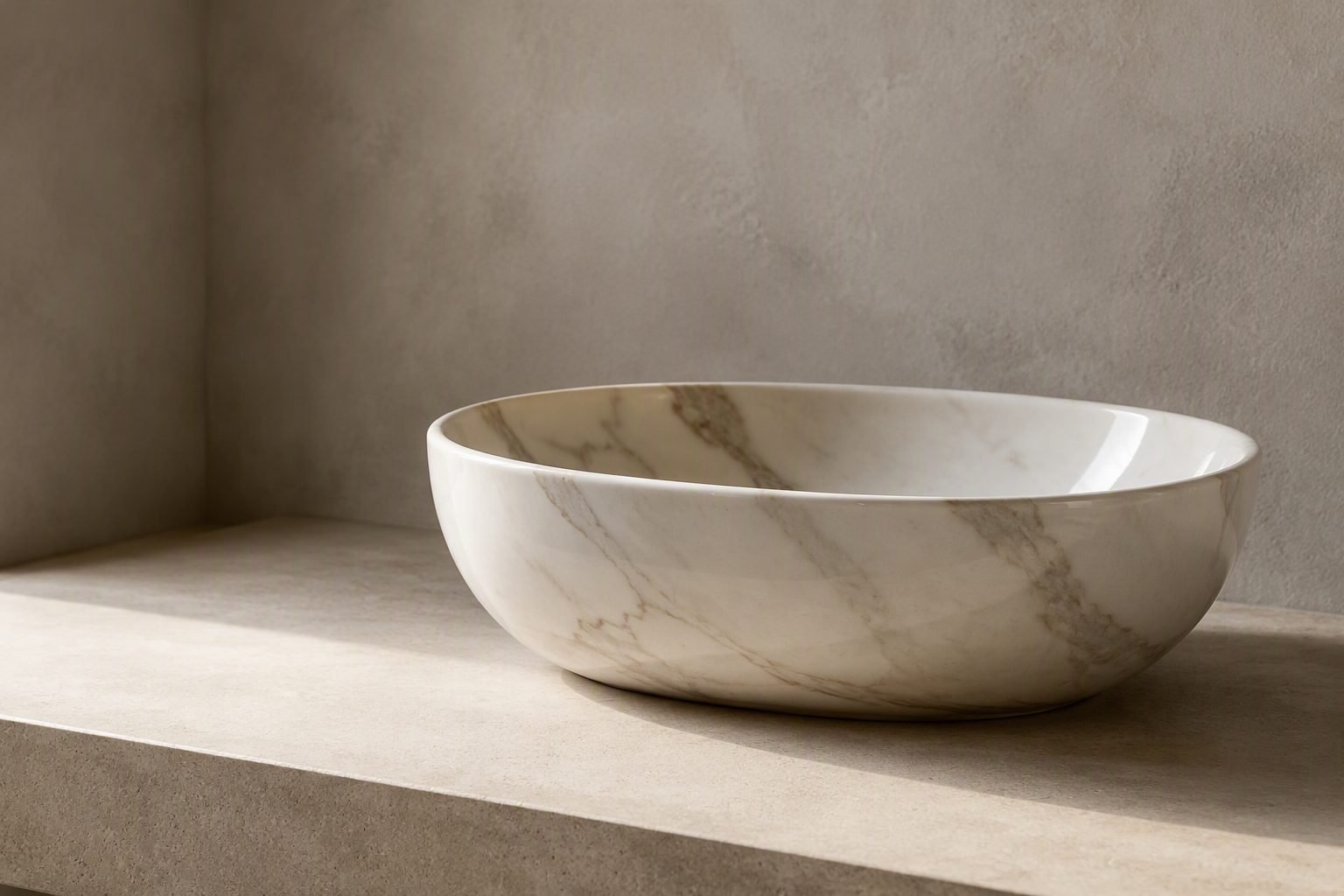
A marble sink is a specification many buyers write into a project brief without settling what the material actually is. In practice the term covers three very different products: basins cut from real quarried marble, basins moulded from resin-based artificial stone, and ceramic basins decorated with a marble effect and sealed under glaze. Each one behaves differently in a bathroom, is priced differently, and survives daily cleaning differently. This guide sets out how a marble-effect ceramic basin is made, how it compares with real stone, what shapes and sizes work in project bathrooms, and the checks a trade buyer should run before placing a container order.
What Buyers Mean by a “Marble Sink”
The phrase is usually a description of appearance, not of material. A specifier asking for a marble sink in a hotel refurbishment is normally asking for the veined, stone-like look — and the moment that becomes the requirement, the material is open to choice.
That distinction matters because appearance-led specification lets you pick the substrate that performs best. Ceramic, artificial stone and quarried marble all deliver a stone-look surface, but only two of them are practical for volume bathroom projects.
When we receive an enquiry for a marble sink, the first question we ask is whether the fabricator or end client has specified a true stone body. Most projects, once the maintenance and freight implications are explained, move to a marble-effect ceramic or artificial stone basin.
Real Marble vs Artificial Stone vs Marble-Effect Ceramic
Three material families sit behind the same visual brief. Understanding the trade-offs is the fastest way to avoid a costly specification error.
Quarried marble basins are fabricated from solid stone blocks. The veining is genuine and no two pieces match. The drawbacks are structural and economic: marble is heavy, it is porous unless repeatedly sealed, and it is sensitive to acidic cleaners — the same acids found in everyday bathroom products etch the surface permanently. Repeated sealing is required, and in a hotel the maintenance regime has to be written into housekeeping procedures. Cost per basin is the highest of the three, and freight cost rises with weight.
Artificial stone basins are moulded from a dense resin blend with stone-like texture running through the body rather than sitting on the surface. The result is non-porous, impact-resistant, warm to the touch, and lighter than quarried stone. It can be cast into seamless, sculptural shapes that are difficult or impossible to achieve in ceramic. The look is contemporary and consistent across a production run.
Marble-effect ceramic basins start as high-fired vitreous china and receive a marble pattern that is then sealed under a protective glaze layer. The body is dense and non-porous, the surface is smooth and wipeable, and the pattern cannot wash off because it sits beneath the glaze. This is the highest-volume option for project supply, and it is the material behind our own marble design basins.
| Factor | Quarried marble | Artificial stone | Marble-effect ceramic |
|---|---|---|---|
| Appearance | Genuine stone veining, unique pieces | Consistent stone-like texture through body | Printed veining sealed under glaze |
| Water absorption | Porous, requires sealing | Non-porous | Non-porous vitreous china |
| Weight | Very heavy | Moderate | Moderate |
| Acid sensitivity | Etches permanently | Resistant | Resistant |
| Maintenance | Regular resealing | Wipe clean | Wipe clean |
| Pattern consistency | No two pieces match | Consistent | Consistent across a production run |
| Best for | One-off luxury features | Premium hospitality, sculptural forms | Volume projects, hotels, distributors |
For a project ordering in volume, the decision usually comes down to artificial stone versus marble-effect ceramic. Both are non-porous and low-maintenance; the choice is driven by shape complexity, budget, and how closely the client wants to imitate a specific quarry reference.
How the Marble Look Is Produced on Ceramic
Understanding the production process tells you what to check in a sample — and where cheap product fails.
Water-transfer printing
The pattern is applied by water-transfer printing. A printed film carrying the vein design is floated onto water and transferred to the basin body before firing. Because the pattern is transferred rather than painted or sprayed, it can reproduce fine veining and soft colour transitions that would be difficult to achieve by hand. Different models in a range carry different patterns, which is why a collection can offer several stone references rather than a single repeated design.
Glaze sealing and firing
After decoration, a protective glaze layer is applied and the piece is fired at high temperature. The glaze fuses into a smooth, sealed surface that locks the pattern in place. This is the step that separates a durable marble-effect basin from a decorative one: because the design sits beneath the glaze rather than on top of it, it does not wash off, fade or wear through with normal bathroom cleaning.
The fired surface is also what makes the basin practical. Vitreous china produced at high temperature is dense and non-porous, so it does not absorb water and stains do not penetrate the body.
Why pattern consistency matters in volume orders
A single basin is judged on its own appearance. Two hundred basins in a hotel are judged against each other. Pattern consistency across a production run is therefore a specification point, not a detail — and it is one of the main reasons marble-effect ceramic suits volume projects better than quarried stone, where natural variation between pieces has to be accepted and managed.
Sample approval is the practical control. For project quantities, we issue pattern samples so the client can confirm vein density, colour depth and surface quality before production starts.

Shapes That Carry a Stone-Effect Glaze Best
Stone-look decoration reads most convincingly on shapes with generous, continuous surfaces. Veining needs room to flow; if it is broken by tight radii or complex ribs, the effect becomes busy and stops resembling stone.
In practice the formats that work best are:
- Round basins — the simplest and most forgiving form. A round basin gives the pattern a continuous field and suits both contemporary and traditional bathrooms.
- Oval and oblong basins — the longer field allows veining to run lengthwise, which is closer to how stone is cut for countertops.
- Rounded rectangular basins — softened corners keep the edge transition smooth, so the pattern reads continuously across the bowl.
- Sculptural, organic rims — shaped rims add movement, but they work best with a restrained, linear vein so the form and the pattern do not compete.
Highly irregular or heavily textured bowls are better served by solid colour glazes, where the shape itself carries the design intent.
Sizes and Formats for Project Bathrooms
Countertop and wall-hung configurations both exist in the marble-effect range, and the sizes available span compact cloakroom basins through to wide vanity bowls. In our own marble design range, countertop models run from roughly 235 × 235 × 80 mm at the compact end to around 860 × 390 × 125 mm at the largest.
| Basin type | Typical footprint | Where it is specified |
|---|---|---|
| Compact round | Small square footprint, shallow depth | Cloakrooms, guest WCs, small apartments |
| Standard round | Mid-size round bowl | Guest bathrooms, residential vanities |
| Oval / oblong | Elongated bowl | Hotel guest bathrooms, twin-vanity layouts |
| Rounded rectangular | Wide rectangular bowl | Contemporary residential, serviced apartments |
| Large vanity bowl | Wide, deeper bowl | Master bathrooms, suites, public washrooms |
Two practical notes for buyers. First, dimensional drawings should always be requested for the specific model rather than assumed from a category page — rough-in details, drain position and rim thickness vary between moulds. Second, if your project mixes marble-effect ceramic with artificial stone basins, check the two ranges against the same worktop layout, because the visual weight of the two materials differs even at the same nominal size.

Finishes: Gloss, Matte and Textured
Gloss remains the default finish for stone-effect ceramic, and for good reason: a polished surface mimics the reflective quality of honed-and-polished stone and is the easiest to clean. It also shows water spotting more readily than matte, which matters in hard-water regions.
Matte finishes suit interiors where the surrounding palette is already muted, and they hide limescale better in the short term. They require the same cleaning routine, but a mildly abrasive cream cleaner should still be avoided because it dulls the matte surface unevenly.
The important point for buyers is that finish is a specification line, not an assumption. If the project needs matte, it must be written into the purchase order, because a gloss basin cannot be converted after firing.
Specification Checklist for Trade Buyers
Before confirming a container order of marble-effect basins, confirm the following:
- Installation type — countertop, wall-hung, or drop-in, matched to the vanity or wall construction.
- Nominal and actual dimensions — request the model drawing, not a generic size.
- Tap-hole configuration — number and position of holes must match the specified tap.
- Drain and trap arrangement — confirm whether the model needs a specific waste fitting.
- Finish — gloss or matte, confirmed in writing.
- Pattern approval — for volume orders, approve a physical sample and retain the reference.
- Colour consistency across the batch — agree the acceptable variation before production.
- Certification for the destination market — confirm which certificates apply.
- Packaging standard — confirm edge protection and carton specification for sea freight.
- Qty per container — agree the loading plan in advance to control freight cost.
Items 1 to 4 are the ones that most often cause site-level problems, because they are decided by the contractor rather than the buyer and are easy to leave until too late.
Installation Notes: Countertop and Wall-Hung Basins
Countertop basins sit on the vanity top and are sealed at the base with a bead of sanitary silicone. The two practical rules are support and clearance: the worktop must be flat and rigid enough to carry the basin’s weight without flexing, and there must be enough rim space either side for the tap and for splash clearance. As a working guide, plan on leaving at least 50 mm of clear counter surface around the basin perimeter, and set the tap so the spout reaches over the bowl without the water stream hitting the rim.
Wall-hung basins depend on the wall, not the basin. The fixing must reach solid structure or a properly rated support, and the trap arrangement — concealed or exposed — should be agreed with the plumber before the rough-in is closed up. Retro-fitting a concealed trap after tiling is significantly more expensive than deciding it in advance.
Vessel-style countertop bowls need one extra check: tap height. If the tap spout is set too low relative to the rim, water splashes out of the bowl on every use. The correct spout height depends on the bowl depth, so it should be verified against the model drawing rather than assumed from the tap specification sheet.
Care and Cleaning
A glazed marble-effect ceramic basin needs no special treatment, which is precisely why it suits commercial bathrooms. Clean with warm water, a soft cloth and a mild bathroom cleaner, then rinse. Avoid abrasive powders, scouring pads and aggressive acidic or caustic descalers; the glaze will tolerate normal bathroom cleaners but not repeated abrasion.
Hard water is the commonest cosmetic issue. Limescale deposits are a mineral film on the surface, not damage to the pattern, and they lift with a mild descaling product. Keeping to a routine wash-down is cheaper than periodic heavy descaling.
Because the pattern sits beneath the glaze, there is no separate design layer to protect, seal or re-finish. That is the central maintenance advantage over quarried marble, where sealing is a recurring task rather than a one-off.

Cost, MOQ and Lead Time for Project Volumes
Cost in this category is driven by mould complexity and finish, not by the marble effect itself. A standard round or oval marble-effect basin sits at the accessible end of the range; large bowls, shaped rims and matte finishes sit above it. Because the material is ceramic rather than quarried stone, the cost difference against a genuine marble basin is substantial, and freight cost is lower because vitreous china is lighter than solid stone at the same bowl volume.
For project supply, our standard terms are a minimum order quantity of 50 pieces per model with a lead time of 25–35 days from order confirmation, and mixed-container loading so that basins can be consolidated with vanities, toilets and other sanitaryware in a single shipment.
The commercial advantage of consolidating is easy to underestimate. Buying basins, vanities and sanitaryware from separate suppliers multiplies freight, documentation and inspection cost; combining them into one container typically reduces the landed cost of every line in the shipment. Our project buyers routinely build a single container around a bathroom package rather than a single product.
Frequently Asked Questions
Q: Is a marble-effect ceramic basin made of real marble?
A: No. It is made from high-fired vitreous china with a marble pattern applied by water-transfer printing and sealed under a protective glaze. The look is marble; the body is ceramic. That is why it is non-porous, lighter than stone and simple to clean.
Q: Will the marble pattern fade or wear off?
A: No. The pattern is fused under the glaze, not printed on top of it, so it does not wash off, fade or abrade under normal bathroom use and cleaning.
Q: How does a marble sink compare with real marble for a hotel project?
A: Real marble requires regular sealing, is sensitive to acidic cleaners and is heavy to ship. A marble-effect ceramic basin is non-porous, needs no sealing, tolerates standard bathroom cleaning and is lighter, which is why it is usually the more practical choice for volume hospitality projects.
Q: Will all the basins in my order look identical?
A: Pattern consistency across a production run is controlled through the printing process, and this is one of the advantages over quarried stone, where every piece differs. We still recommend approving a physical sample for volume orders so the acceptable pattern and colour range is agreed in advance.
Q: What sizes are available?
A: Countertop models in our marble design range run from approximately 235 × 235 × 80 mm to 860 × 390 × 125 mm. Because rough-in details vary between moulds, request the dimensional drawing for the specific model rather than relying on a category-level size range.
Q: Can the basins be supplied in matte rather than gloss?
A: Finish is a production specification, so it must be confirmed before the order is placed — a fired gloss basin cannot be converted to matte afterwards. Confirm gloss or matte in writing on the purchase order.
Q: What are the MOQ, lead time and certification options?
A: Standard terms are 50 pieces per model with a lead time of 25–35 days from order confirmation. Depending on the model and destination market, certificates such as CE, CUPC, WaterMark, SAA, ETL and UL can be supplied. Tell us your target market and we will confirm the applicable set.
Conclusion
Choosing a marble sink for a bathroom project is really a decision about material, not appearance. Marble-effect ceramic basins deliver the veined, stone-like look on a non-porous vitreous china body that needs no sealing, tolerates standard commercial cleaning and ships lighter than quarried stone — which is why they hold up so well in hotel and multi-unit residential work. Artificial stone remains the better answer where sculptural, seamless shapes are the priority. Confirm the specification early, approve a pattern sample for volume orders, and settle the installation details with the contractor before production begins. If you are sourcing a marble sink line for a project, send us your quantity, preferred shapes and destination port, and our team will come back with patterns, samples and factory-direct pricing.