
How to Choose the Right Ceramic Basin for Your Bathroom
Why the Basin Choice Matters More Than You Think
The wash basin is the most-used surface in any bathroom. It takes the daily wear of taps, splashback, cleaning chemicals, and heavy use — yet it is often chosen last, after tiles and vanities. A basin that is too small splashes constantly. One with the wrong mounting type creates awkward plumbing work. One with a fragile glaze stains within months.
For contractors, distributors and hotel buyers, the stakes are higher: a wrong specification multiplied by 200 rooms is an expensive mistake. This guide is written for both homeowners and B2B buyers, based on what actually gets ordered from a ceramic basin factory.
Step 1: Choose the Mounting Type
The mounting type determines how the basin sits and how it is plumbed. There are five common configurations:
| Mounting Type | Best For | Plumbing | Notes |
|---|---|---|---|
| Countertop (above-counter) | Modern bathrooms, easy installation | Simple | Basin sits on the countertop; full silhouette visible |
| Vessel (self-rimming bowl) | Design-led projects | Simple | A countertop basin with a sculptural look |
| Wall-hung | Small bathrooms, accessible design | Concealed | Frees the floor; needs wall reinforcement |
| Pedestal | Classic bathrooms | Standard | Hides plumbing behind the column |
| Undermount | Minimalist counters | Standard | Basin fixed under the countertop; seamless sweep |
For commercial projects, wall-hung and countertop basins are the most common choices because they make floor cleaning easy and standardize installation.
Browse the full ceramic basin range to compare mounting types side by side, or jump to color-glazed basins if the finish is the deciding factor for your project.
Step 2: Get the Size Right
A basin that looks right in a showroom can feel wrong in a real bathroom. Two dimensions matter most: the bowl depth (to prevent splash) and the countertop cut-out (for countertop models).
As a sizing reference, here are two real products from our production line:
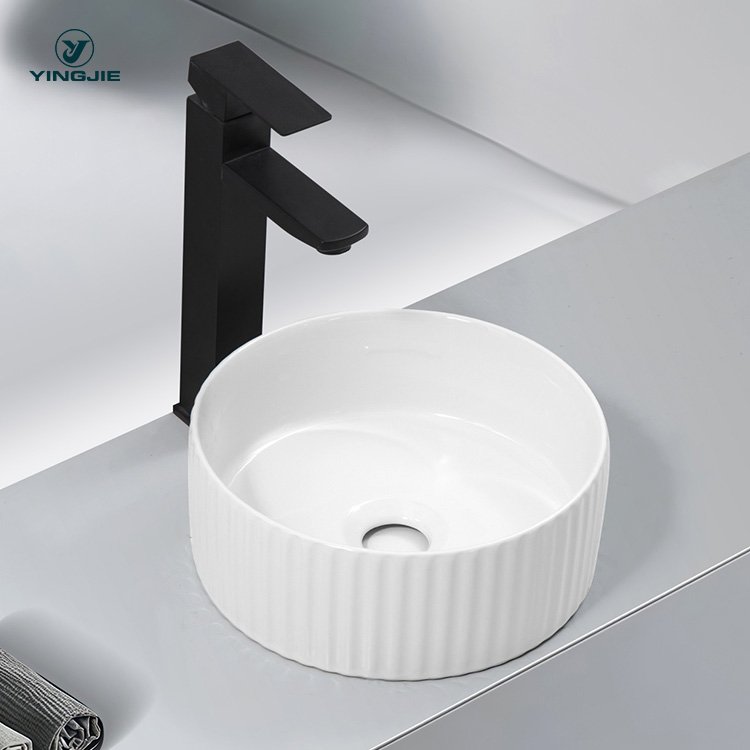
- Ribbed White Vessel Sink (Model 9801A) — 280 × 280 × 110 mm. A compact round bowl for small ensuite bathrooms or guest toilets.
- Sage Green Countertop Basin (Model 9768) — 510 × 395 × 125 mm. A full-size basin for master bathrooms and hotel rooms. View the sage green basin
As a rule of thumb:
- Compact ensuite or guest toilet: 280–350 mm bowl diameter
- Standard bathroom: 400–510 mm basin width
- Hotel standard rooms: 450–510 mm countertop basin
- Handicap-accessible or dual basin: always allow 700 mm minimum between basin centers
Step 3: Understand Ceramic Quality (What Actually Differs)
Not all ceramic basins are equal. The visible differences are in the glaze, the body, and the firing.
| Quality Factor | What to Check | Why It Matters |
|---|---|---|
| Firing temperature | Ask for the kiln temperature (1280°C+ is standard for vitrified ceramics) | Higher firing = denser body = lower water absorption |
| Glaze finish | Matte vs. glossy, hand-applied vs. sprayed | Matte hides fingerprints; glossy is easier to clean |
| Water absorption | ASTM/ISO test results (<0.5% is vitrified) | Low absorption prevents crazing and bacteria growth |
| Edge & rim finish | Smooth, chip-free rim | Chips are the #1 complaint on cheap basins |


Ceramic basins are fired from clay, feldspar and quartz at high temperature. A properly vitrified basin has near-zero water absorption, which is why ceramic remains the standard for sanitary ware — it is hygienic, durable, and colorfast for decades.
How Ceramic Basins Are Made: From Clay to Kiln
Knowing how a basin is made tells you what to ask the factory before you order. The process runs through five stages, and quality control matters at every one of them.
- Body preparation. Ceramic basins are formed from a blend of clay, kaolin, feldspar and quartz. The recipe determines the body’s strength, whiteness and shrinkage in the kiln — a controlled recipe is the difference between consistent batches and surprises.
- Forming. Basins are cast from liquid slip into plaster or resin moulds. High-pressure slip casting produces denser, more consistent walls than low-pressure casting, which is one reason identical-looking basins differ in durability between factories.
- Drying and finishing. After demoulding, the greenware is dried and hand-fettled — edges smoothed, holes cut for the tap and overflow. Edge finish here determines how chip-resistant the final product is.
- Glazing. The glaze is applied by spray or dip. The distinction that matters for buyers: a single thick, controlled glaze layer wears better than thin double layers, and matte glazes hide water marks while glossy glazes are easier to wipe clean.
- Firing. Basins are fired once (bisque) or twice (bisque + glaze). Vitrified ceramic is fired above 1200°C, which fuses the body into a dense, near-zero water absorption material — the property that makes ceramic hygienic and colorfast. ISO 10545-3 water absorption testing (<0.5% for vitrified ware) is the standard way to verify it.
Final inspection covers glaze defects, colour deviation between pieces, edge chips and dimensional tolerance. When a supplier publishes its firing temperature, water absorption test results and inspection process, you can verify quality claims instead of trusting them.
Step 4: Pick a Finish That Fits the Project
The finish is where the basin earns its place in the design. Popular directions in the current market:
- Matte solid colors — e.g., sage green, soft beige. Low maintenance, hides water marks, works with natural-material interiors.
- Stone-look glazes — e.g., black marble with gold veins. Delivers a luxury look at a ceramic price point.
- Textured / ribbed surfaces — adds tactile depth; pairs well with minimal fittings.
- Crackle / electroplated finishes — high-gloss statement pieces for boutique hotels and showrooms.
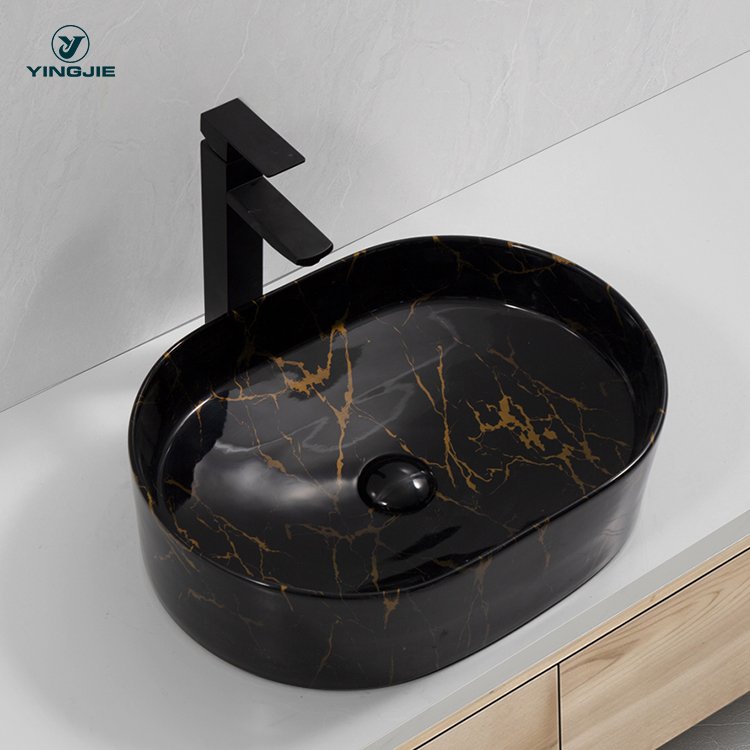
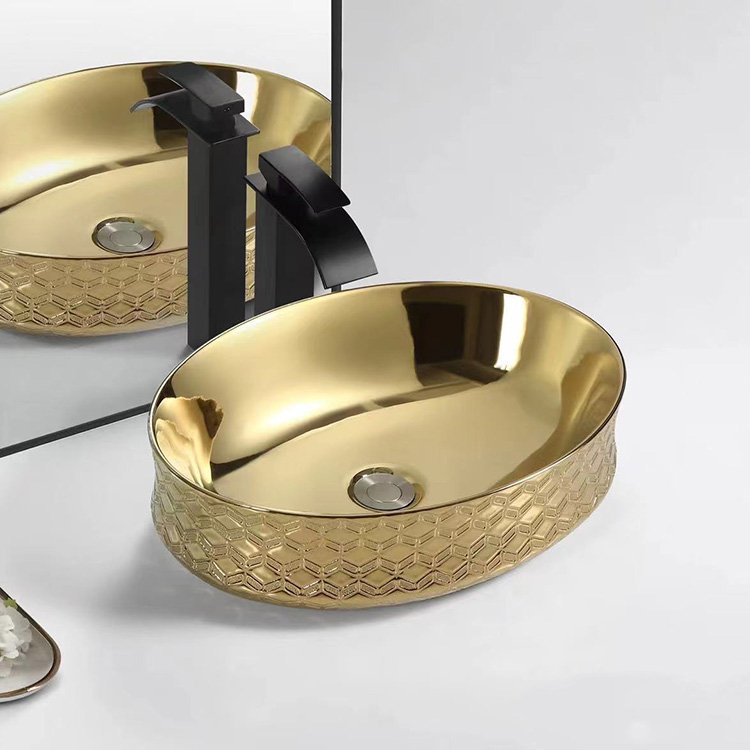
Our current range includes all four directions: the sage green matte basin, the black marble basin with gold veins, the ribbed white vessel sink, and a crackle-finish electroplated basin — each photographed from the factory floor, not from a render.
Step 5: Home vs. Commercial — Different Priorities
| Consideration | Homeowner | Commercial / B2B Buyer |
|---|---|---|
| Main priority | Look & feel | Durability + consistency |
| Order quantity | 1–2 pieces | MOQ matters (e.g., 50 pieces per model) |
| Certification | Nice to have | Often mandatory (CUPC / CE / SGS) |
| Lead time | Flexible | Fixed schedule for project deadlines |
| Customization | Limited | OEM/ODM: custom colors, logos, sizes |

For B2B buyers, three questions matter most before ordering: Can the factory do OEM (custom color/logo)? What is the MOQ per model? What certifications does the product carry? A factory that answers all three in writing is a factory you can plan around.
Commercial Specifications by Project Type
Commercial basins are specified against the project’s usage pattern, not against taste. The practical checklist for each project type:
| Project Type | Recommended Basin | Specification Priorities |
|---|---|---|
| Hotel guest bathrooms | Countertop, 450–510 mm | Matte or stone-look glaze, CUPC/WaterMark certificates, consistent batch colour |
| Healthcare and care facilities | Wall-hung, rounded edges | Floor access for cleaning, smooth glaze that withstands disinfectants |
| Offices and public washrooms | Wall-hung or pedestal | Durable standard glaze, standardized model for fast replacement |
| Restaurants and cafes | Vessel or countertop feature basin | Design impact first, easy replacement second |
| Airports and high-traffic facilities | Heavy-body wall-hung | Vandal resistance, low spares inventory through one standardized model |
Across all commercial projects, three documents protect the buyer: the product certificate, the batch quality report, and a written statement of MOQ and lead time. Our ceramic basin catalogue lists certified models with factory-direct specification, so the documentation comes with the order rather than as a separate chase.
Step 6: Budget Realistically
Ceramic basins are one of the most price-stable categories in sanitary ware. As a rough guide:
- Pricing for a standard countertop basin varies by size, glaze and order quantity — the factory quotation is the reliable reference
- Designer finishes (marble-look, crackle, electroplated): priced above standard glazes, driven by glaze complexity
- Freight is often the bigger cost driver than the basin itself — consolidate models into one container
Basin Specification Checklist for RFQs
When you send a request for quotation, an incomplete specification produces an incomplete price. The checklist that saves the most re-quoting time on ceramic basin RFQs:
- Mounting type and dimensions – countertop, vessel, wall-hung or pedestal, with the exact outer dimensions and countertop cut-out where relevant.
- Finish and colour reference – name the finish (matte, stone-look, crackle) and provide a colour code, pantone reference or approved sample photo rather than a colour name.
- Certification required – state the market standard (CUPC, WaterMark, CE) so the factory quotes the certified version, not a base version.
- Tap hole configuration – one-hole, three-hole or no hole, and the tap hole diameter, because this changes the mould.
- Quantity and target lead time – MOQ and delivery deadline upfront; a 50-piece order on a 25-35 day production cycle needs different planning than a full container.
A complete RFQ gets you a firm quotation instead of a range, and it lets the factory flag mould changes or certification gaps before you commit. Send the same specification to two or three factories and compare the quoted piece price, the sample lead time and the certificate documents side by side.
Frequently Asked Questions
Q: Ceramic vs. solid surface basin – which is better?
A: Ceramic wins on price, colour range and scratch resistance; solid surface wins on seamless integration (no visible rim) and repairability. For standard bathrooms and most hotel projects, ceramic is the value choice.
Q: How do I prevent a countertop basin from splashing?
A: Choose a bowl depth of at least 110 mm and check the overflow design. A 125 mm deep countertop basin is typically specified for exactly this reason in hotel bathrooms.
Q: Can I get a custom colour for my project?
A: Yes. As a manufacturer, we offer OEM glazing in custom colours with a MOQ of 50 pieces per model. Lead time for custom glaze samples is typically 2–3 weeks, with bulk production running 25–35 days after sample approval.
Q: What certifications should a basin have for the US market?
A: CUPC certification is the key requirement for plumbing products in the US market, with WaterMark covering Australia. Always ask the supplier for the certificate document before bulk ordering.
Q: Do ceramic basins stain or yellow over time?
A: A properly vitrified ceramic basin fired above 1200°C does not yellow – that is a solid-surface failure mode, not a ceramic one. Glaze quality is the variable, so buy from a factory that controls its glaze formula in-house.
Q: What is the MOQ and lead time for bulk orders?
A: Standard MOQ is 50 pieces per model with a production lead time of 25–35 days after sample approval and deposit confirmation. OEM/custom glaze development adds 2–3 weeks on top.
Q: How do I check ceramic basin quality before ordering?
A: Ask for the water absorption test report (ISO 10545-3, under 0.5% for vitrified ware), the firing temperature, and a pre-production sample. Check the rim for chips, glaze coverage on the underside, and colour consistency against the approved sample.